In the spotlight

In the spotlight
Consciousness expresses itself through creation

Sunday, 25 October 2015

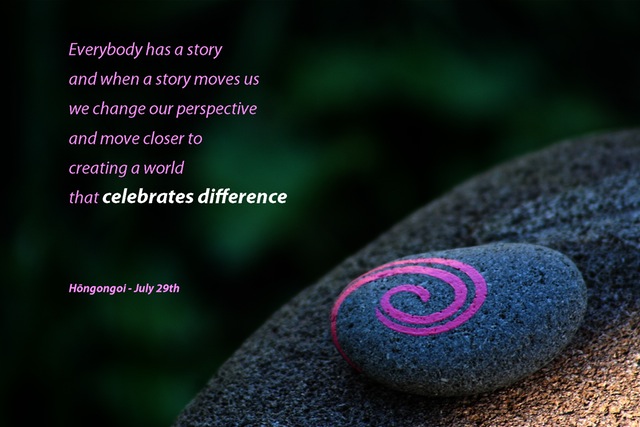
Celebrate Difference

image source:http://www.handpaintedrocks.com/wp-content/uploads/2012/09/Day210_July29th2011_CelebrateDifference.jpg


Following the theme of my last SIG discussion I found the article below in the guardian about people's perception of autism as a disability:

http://www.theguardian.com/science/blog/2015/jul/16/autism-doesnt-have-to-be-viewed-as-a-disability-or-disorder

As I read the article I felt like I was reading a précis of my research findings to date. So far my inquiry has taken me on an incredible journey. I began with a rather timid tiptoe into the autism pool of information with a smattering of knowledge based upon my own previous teaching of people on the spectrum. At this point I suppose the closest way I can describe how I felt about autism would be to liken it to catching a glimpse of something sparkling in a muddy puddle - wanting to explore to see what it is but afraid of delving in and discovering something unpleasant. The more I read and talked to others with experience of teaching people with autism the more I became aware of different attitudes towards it. I found that, in general, those with the most experience of it tended to view autism as a different way of looking at and understanding the world as opposed to being a disability and deviance of the "norm". My view? Look below:

image source: http://www.simplyspiritualliving.org/simply/wp-content/uploads/2014/01/When-you-judge-another-you-do-not-define-them.jpg

Tuesday, 20 October 2015

"Two Sides to every Coin" - SIG discussion

image source:http://i.huffpost.com/gen/1589244/thumbs/o-CHINESE-SCRIPT-570.jpg?4

I read Adesola's Akinleye's blog about the recent Module 3 Skype session and her final comments "The way you capture an idea reflects your relationship with the idea itself" really had a resonance with me because I am currently looking at people's attitudes to autism and trying to formulate my own. 

So much has been written about the deficits of autism that it is tempting to get into the negative mode of considering it a blight. I have just undertaken my first observation of a dance session for my research and that was not the impression I came away with.

I witnessed some young teenagers in an inclusive theatre class rehearsing for their next performance. They all had special needs of some sort. Most were on the Autism spectrum; some had Down's Syndrome, others ADHD and some a mix of these. I have to confess to being somewhat apprehensive about entering the class as I didn't know what I might see. What I saw was a group of talented individuals with an evident love of performing arts. I soon forgot about the fact that they had special needs.

I realised that my apprehension had been due to the fact that I had been studying the common traits of autism and looking at methods that specialists are using to try to help address the challenges they present. I had, for example been reading case studies of how Applied Behaviour Analysis (ABA) was implemented for severe behavioural problems and how the Picture Exchange Communication System (PECS) was helping those who were non verbal and had difficulty understanding and processing spoken instructions. In so doing I had become daunted by the severity of some of the conditions and the challenges that many on the spectrum face.

This observation had reminded me of the old adage "there are two sides to every coin". I thought back to my blog : "Dancing to a Different Rhythm" that I had written in Module 2. In this I commented on an article by Andrew Palermo which took the view that we should just accept people with autism as they are and for whom they are and not try to change. Some people, after all, see autism as a gift; one such individual is a 14 year old boy with Asperger's syndrome. The link to the article is below:

http://news.bbc.co.uk/1/hi/health/3106599.stm


I found a very interesting article about the view put forward by Dr Laurent Mottram that "unusual activity in autistic people's brains should be seen as 'evidence simply of their alternative, yet sometimes successful, brain organisation.'

He maintains that people with autism often outperform those not on the spectrum in both auditory and visual tests and that:

 "'It's time to start thinking of autism as an advantage in some spheres, not a cross to bear,' 

The link to this article is below:


http://www.dailymail.co.uk/health/article-2056941/Autism-advantage-Valuable-traits-include-exceptional-memory-visual-skills.html


I thought this would make a good discussion amongst my SIG so I posed it to them.

Most of them had had experience teaching at the mild end of the spectrum and they were of the opinion that people with autism often have talents in certain areas and that autism shouldn't necessarily be seen in a bad light. One or two felt however, that it would be hard to think of having autism as being an advantage because of the challenges associated with it.

A couple of my colleagues also questioned how someone at the severe end of the spectrum who was non-verbal, had extreme behavioural challenges and couldn't function independently could possibly be seen as being in any way at an advantage.

I personally think that Mottram was not attempting to make light of the problems many on the spectrum can face, but rather to point out that there are those who are high functioning who do have talents and are extremely intelligent and we should remember that. Just because they think differently from what we perceive as the norm does not mean to say that we should think any less of them- do not undervalue people with autism. 

I had been very impressed with the talent and confidence of the students I had observed. I made a note in my reflective journal to remember the positive feeling I had come away with, but also to try to remain neutral in my final writing. It is difficult once you have met the individuals, not to let your personal feelings influence your writing. 

Tuesday, 13 October 2015

Tuesday, 6 October 2015

Communication - Thoughts on a BAPP group Skype session

Image source:http://www.parentmail.co.uk/wp-content/uploads/2014/03/Discussion.jpg

SKYPE GROUP SESSION OCTOBER 6th

Our group Skype session consisted of several people from  Modules 1 and 2 and  just myself from Module 3. I would have liked to have had some more Module 3 people in the group to hear how they are progressing with their inquiry research but it was really interesting to talk to people from Modules 1 and 2 and hear their views about different elements within the course.Having people from all three Modules enables people to get a clear view of the course as a whole and how it progresses. 

People from Module 1 were voicing the same feelings of confusion and anxiety that I had felt about which writing style to adopt for their blog and what the expectations were from the tasks within the Module. Their comments reminded me of   my initial thoughts when I first embarked upon the course. I think it's true to say that you experience those same feelings of apprehension and self doubt at the start of every Module but how you tackle them is all a part of the reflective process.

Discussing ideas with others can also make your own rather vague concepts suddenly become clear. Hearing what people think of your ideas can help add a different dimension to your own thought process or maybe give you a fresh focus.

The group Skype sessions are also a good preparation for the question and answer session after your oral presentation at the end of Module 3. If, like me, you have difficulty in voicing your thoughts in an organised and clear way then this is a good way to practice!


It is important to connect with people on BAPP as well as exchanging thoughts with work colleagues if only to realise that you are not alone in your anxieties.


My Inquiry - SMART planning

Image source : http://mmewaters-3wf.wikispaces.com/file/view/inquiry_model.gif/155445769/inquiry_model.gif

Module 3 is here and with it looms my Inquiry- panic is setting in - time for some SMART planning.

SMART stands for : Specific, Measurable, Achievable, Realistic and Timebound.I discovered this when following the link in Reader 7 to the following website:

http://www.open.edu/openlearn/money-management/management/business-studies/planning-project/content-section-7.1.1 .

In my reflective journal I took each of these headings in turn and had a brainstorming session. This is what I came up with:


SPECIFIC

DECIDE ON INQUIRY QUESTION
DONT GET SIDE TRACKED
FOCUS IN ON WHAT IS IMPORTANT - WHAT DO I WANT TO KNOW?
HOW CAN I CONVEY WHAT I WANT TO KNOW?
CLEAR AIMS AND OBJECTIVES

MEASURABLE

HOW DO I ASSESS THE INFORMATION?
CONSIDER METHODS OF ANALYSIS-
DATA TRIANGULATION?
OBSERVATIONS- INTERVIEWS- DATA COLLECTION- LITERATURE

ACHIEVABLE

CAN I FIND OUT WHAT I WANT TO KNOW?
WHO CAN HELP ME- SIG- EXTERNAL COLLEAGUES- LITERATURE-
FINANCIAL RESTRAINTS- PLACES FOR OBSERVATION ARE FAR AWAY- PRACTICALITIES OF GETTING THERE- USE SOCIAL MEDIA TO ASK ADDITIONAL INFO TO MINIMISE AMOUNT OF VISITS NECESSARY.
ETHICS
PERMISSION

REALISTIC

DONT HAVE TO FIND AN ANSWER
DONT BE TOO AMBITIOUS
DON’T TRY TO CHANGE THE WORLD!

TIMEBOUND

BE SELECTIVE WITH READING
DO A TIME PLAN FOR THE INQUIRY
BE ORGANISED!

The biggest problem for me will be the time constraints. I tend to get carried away reading and have all these thought buzzing round my head which take ages to sort into some semblance of order. Does anyone else have that same problem?

Once I had identified what SMART planning meant to me I tried to see how I was applying it and wrote down a list in my journal of things I had done and things I still need to do.

INQUIRY

 DONE.

NARROWED DOWN  INQUIRY QUESTION.

DECIDED INQUIRY TOOLS WILL BE OBSERVATIONS AND INTERVIEWS - NOT GATHERING DATA FROM QUESTIONNAIRES. 

READDRESSED THE INSIDER RESEARCHER STANDPOINT AND CONSIDERED ETHICAL IMPLICATIONS

GOT ALL RELEVANT PERMISSION 

DONE A TIME PLAN

ARRANGED DATES FOR VISITS

USED SOCIAL MEDIA TO MAKE CONTACT WITH EXPERTS IN THE FIELD TO GET THEIR INPUT - SKYPE INTERVIEWS, EMAILS, GOOGLE +, SIG

GATHERED LITERATURE AND IDENTIFIED EXPERTS IN THE FIELD - FOUND SOME QUOTES THAT MIGHT BE USEFUL AND PUT THEM AND OTHER WEB SOURCES IN EVER NOTE

POSTED SOME BLOGS ON INITIAL  INQUIRY THOUGHTS

DECIDED UPON IDEA FOR PROFESSIONAL ARTEFACT


TO DO

MAKE AN OBSERVATION CHART TO DECIDE WHAT TO FOCUS ON

CONDUCT OBSERVATIONS

CHOOSE METHOD/S OF ANALYSIS

CONTINUE READING

CONTINUE BLOGGING

CONTINUE GETTING FEEDBACK AND IDEAS FROM SIG, TUTOR, OTHER PROFESSIONALS

WRITE CRITICAL REVIEW

PRODUCE ARTEFACT

PLAN PRESENTATION 

WRITE INVITATIONS AND ISSUE TO PARTICIPANTS- DEBRIEF

GIVE PRESENTATION !


I found that the process of organising my thoughts from the brainstorming session into an action plan was very helpful because it made me realise that I had actually made more progress towards my research than I had initially thought I had and this in turn made the task ahead seem less daunting. I am still unsure how best to analyse my findings so am now doing some further reading about observational analysis. I would be interested to hear from anyone else who has chosen this inquiry tool.

  Thought for the day:

  "If you don't know where you're going you'll end up someplace else" (Berra ,Y http://articles.bplans.com/8-quotes-to-motivate-you-to-make-a-plan-and-stick-to-it/ )

"I AM DIFFERENT NOT LESS" - DR TEMPLE GRANDIN - A review of "Curious Incident"

              Image source: https://iusedtoeatmarlborolightsbypaulanolanphotography.files.wordpress.com/2014/09/988811_760230753990219_1975658452_n.jpg?w=1200

I have just seen the National Theatre's production of "The Curious Incident of the Dog in the Night Time". They brilliantly portrayed Mark Haddon's story about a young boy with Asperger's syndome who investigates the brutal killing of a neighbour's dog and, in so doing, discovers that his father has lied to him about his mother's sudden disappearance.

It is told through the eyes of the teenage boy, Christopher Boone, and gives a tremendous insight into the different thought process a person with Asperger's has.

Dr Temple Grandin, a leading expert on autism, states :


"...the brain of an individual with autism overreacts to sensory stimulation. The overreaction occurs in both the sensory cortex and emotional centres that activate fear." (Temple Grandin, M, p 3, 2015)

This is very effectively depicted with the use of lighting, projection, sound and clever staging in moments throughout the play; one such incident is the panic that is portrayed when Christopher first encounters trains and the London underground on his journey to try to find his mother.

 It also shows a typical autistic trait of being unable to assess danger when he leaps onto the Tube track to rescue his pet rat, who has escaped from the small cage in which Christopher has been carrying him. Nail biting suspense is created as we hear the train approaching and the boy is oblivious to his approaching fate- he is pulled back to safety in the nick of time by a man and woman on the platform.


 For some people on the autism spectrum "touch makes the person feel overwhelmed and often leads to avoiding touch when possible. They may be sent into fight or flight over very small, everyday touch sensations." ( Kid Companions, 2013 ) Christopher hates being touched and his only way of showing affection is by offering his palm for brief contact with that of his father or mother.


In the play, whenever Christopher gets distressed at home, especially during arguments with his father, he plays obsessively with his train set and blocks out anything being said to him. The National Autistic Society states that the reasons behind repetitive behaviour in people with autism may be:
  • an attempt to gain sensory input, e.g. rocking may be a way to stimulate the balance (vestibular) system; hand-flapping may provide visual stimulation
  • an attempt to reduce sensory input, e.g. focusing on one particular sound may reduce the impact of a loud, distressing environment; this may particularly be seen in social situations
  • a way to deal with stress and anxiety and to block out uncertainty. Some adolescents or adults may revert to old repetitive behaviours such as hand-flapping or rocking if anxious or stressed
  • a source of enjoyment and occupation (National Autistic Society, 2015)

The fact that people on the autism spectrum are often extremely intelligent and talented in certain areas is shown by Christopher's aptitude for maths and his memory skills.He says he can name each country in the world, their capitals, and every prime number up to 7,057. 

Despite giving the audience a glimpse into some of the anger, frustration, confusion and despair that people on the autism spectrum can feel, the play also interjects humour and ends on a positive note with Christopher attaining an A* for his A level maths at the age of 15.

I found this play inspirational and very helpful for my research into autism. I had been having some thoughts about my professional artefact for BAPP and how I could use the knowledge I have acquired in a creative way and this play was a perfect example of how this can be achieved. It gave me a great deal of food for thought and I jotted down lots of ideas in my reflective journal on my journey home from the theatre.

I liked the fact that the play, whilst highlighting all the negative aspects of autism, didn't wallow in negativity. Instead it  left us with the thought that people with autism just have a different view of the world and think in different ways and are not necessarily disadvantaged but can possess brilliant minds and go on to achieve great things. Christopher conveys a message of hope and optimism for the future with his concluding words:  " does that mean I can do anything?"


"If we are willing to look without preconceived judgment, then the autistic has done his or her work and we can begin to build the bridges between that other world and the world we know. We can bring the best qualities of that world into ours and allow the autistic child or adult to find their way to bridge into our world too. " (Sahyew, L, 2015 )

BIBLIOGRAPHY

Kid Companions, 2013 Tactile Sensitivity-What It Is and the Common Signs, online:http://kidcompanions.com/tactile-sensitivity-what-it-is-and-the-common-signs/#sthash.6Y5qAY59.dpuf


National Autistic Society, 2015, "Repetitive Behaviour and Autism", online:  http://www.autism.org.uk/living-with-autism/understanding-behaviour/obsessions-repetitive-routines/repetitive-behaviour.aspx

Sahyew, L, 2015, The Gifts of Autism, online: http://thegiftsofautism.com

Temple Grandin, M, 2015, Temple Talks About Autism and Sensory Issues, Sensory World


Wednesday, 30 September 2015

Updates on inquiry progress and sharing discoveries

image source: https://www.lumus360.co.uk/360blog/wp-content/uploads/2013/11/360-feedback-process.jpg


  FEEDBACK

The feedback I received from Module 2, together with a very helpful discussion with Adesola, has helped me realise that the original questions I wanted to ask for my research needed some adjustment.


ORIGINAL INQUIRY QUESTIONS

I began with the questions:

• “What methods are dance teachers implementing for their pupils with ASD and are there any additional strategies they could put in place to enhance the dance learning experience for people with ASD?”

• “Do people/parents of people with ASD feel that dance has helped them/their child in any way in their lives and what has their past dance experience been like?”

• “Would dance teachers who are not specialist in the field of autism be interested in attending local courses/workshops on this subject that might provide teaching strategies they can implement in their existing classes?” 


PURPOSE OF MY RESEARCH 
                                
The purpose of my research is threefold :

1. to gather as much information as I can about the different approaches people are using to the teaching of dance for the autistic range.

2. to see if there are any methodologies that experts in the field of dance teaching for people with ASD implement that are new to me and that I can adopt to enhance my own teaching.

3. to develop this further to devise my own syllabus for the autistic range of dance students.


 INQUIRY FOCUS

I have now realised that, although my intention is the same, the time constraints of the inquiry will necessitate my focusing more on one aspect of my research. This was a difficult decision for me. In making my choice I found the following Youtube video helpful. It emphasises the importance of adding context to help you focus your inquiry:

https://www.youtube.com/watch?v=nXNztCLYgxc


I have therefore decided,for the inquiry, to concentrate my efforts on mapping out some of the different teaching approaches for people with ASD. 


NEW INQUIRY QUESTION

My main inquiry question will now be:


“ What are some of the approaches currently being used for teaching dance to people on the autistic range?”

The literature I have read to date has already shown me that there are many different teaching approaches and I obviously can’t include them all, so, for the purpose of my research, I will compare the methodologies implemented by two organisations in the UK that specialise in the provision of dance for people with autism and by one autism expert in the USA. These are :

1. An inclusive theatre performance course approach

2. A holistic approach

3. An autism movement therapy approach

 I will then use literature to support or contrast their methods and show how they developed.

Throughout my inquiry I will be drawing on my own past and present teaching experience and comparing the methods I use with those of the teachers I am interviewing. My ultimate aim is to further enhance my own teaching by the additional knowledge that I gain through watching and reading about dance teaching for people on the autistic spectrum.


FURTHER RESEARCH POSSIBILITIES

After the BAPP course I would like to explore this further, possibly by doing an MA, and at this point I hope to use the information I have gathered in my inquiry as a base to develop my own syllabus for teaching students on the autistic range.

My pilot questionnaire, which was distributed amongst dance teachers and examiners, to ascertain if there was a need for courses about teaching dance to people on the autism spectrum, indicated that teachers would welcome this. I realise that a limited distribution can only ever be indicative and cannot yield sufficient information and so I have decided not to pursue this aspect for my inquiry. This is something I will look at in more detail after the BAPP course.


COLLEAGUES' INPUT

I inserted comment boxes into the questionnaires and these have provided me with some very useful information about people's experience of teaching their pupils on the autistic range so I will refer to this in my research rather than gathering statistical data. I will also get input from my SIG about their teaching experience as some of them teach pupils on the autistic spectrum.


ETHICS

It was thought that talking to the pupils about their dance experience was not appropriate for ethical reasons because they are vulnerable adults. This made me look again at the ethics concerning my research. I found the following website helpful:

https://www.edgehill.ac.uk/research/files/2012/05/Ethics-Output-Guidance-Vulnerable-Adults-RO-GOV-11.pdf


I have decided I will not question the pupils about their dance learning experience. Instead, I will ask their teachers about any differences they have noticed in their pupils since they began teaching them. I feel this is important as it will help me to get a feel for the long term effectiveness of the teaching methods they are using and to decide, which, if any, of them to try out in my own teaching.

 Although I will be an outsider observing the sessions, the prior teaching experience that I bring to the inquiry could influence the way I view the work I observe so I have to ensure that I maintain objectivity throughout my research.

The above website states:
       
 "Where an adult is incapable of giving consent, researchers should, without compromising the rights of the individual, consult with those who have a duty of care towards that person. This may include family and/or statutory carers."

This made me realise that, as well as getting my signed consent from the organisations to conduct my research, which will involve my observing vulnerable adults, I needed to get permission to talk about the past teaching experience of those individuals. After discussing this point with my professional contacts at the organisations it has been agreed that they will obtain this permission prior to my visiting.

I intend to make my presence as unobtrusive as possible in the observations and to be prepared to leave the room if necessary.


SUB QUESTIONS

Adesola mentioned that other sub questions may arise as my research unfolds and I agree with this. I think that the research will be an organic process and different areas of study may present themselves along the route. I also think that there is a danger of getting side tracked by additional questions that may arise, so it is important to acknowledge them and pursue them if they are particularly pertinent to the inquiry, but also to stay focused on my main question because of the limited time available. 

One such sub question has already arisen since my chat with Adesola .It was prompted by reading the following article below that was put up on Lianne's blog about Skinner Release Technique; this dance technique "aims, not to relax the body, rather to prepare the body to be available to any image or creative idea- releasing imagination."

http://www.communitydance.org.uk/DB/animated-library/in-its-purest-form.html?ed=14067

 I started to think about the imaginative process involved in improvisation and this provoked the question :


"How do people on the autistic range respond to improvisation?"

It will be interesting to discover if improvisation is used in the dance teaching at the organisations in which I am carrying out my research. If so, then this question might be useful to consider.


RESEARCH TOOLS AND  QUALITATIVE ANALYSIS

When I piloted my inquiry tools for Module 2 I reached the conclusion that I would conduct my research using classroom observations and interviews. Having read Reader 7 and reread Reader 6 I am now looking at ways that I might analyse the information that I collect. I would be interested to hear what methods of analysis others on BAPP who are using these tools are planning to implement. 

I came across the following prose by Alder when I was doing some googling about research methods. It made me reflect upon the insider researcher standpoint. I am not conducting my observations in my own workplace so I will be an outsider researcher for these. I am, however, making comparisons with my own work so my teaching experience is bound to affect my judgement in some way. It is easy to bring your own feelings, preferences and prejudices into the research. It reminded me of the importance of trying to be open minded in my attitudes to the research and of endeavouring to maintain objectivity. It is inevitable, however, that who we are and the way we think and feel will influence what we read, what we research and the conclusions we draw .As Adler states:

“Read it with sorrow and you will feel hate.
Read it with anger and you will feel vengeful.
Read it with paranoia and you will feel confusion.
Read it with empathy and you will feel compassion.
Read it with love and you will feel flattery.
Read it with hope and you will feel positive.
Read it with humor and you will feel joy.
Read it with God and you will feel the truth.
Read it without bias and you will feel peace.
Don't read it at all and you will not feel a thing.” 

― Shannon L. Alder